The Ultimate 4-Day Da Nang & Hoi An Itinerary for First-Timers (2026 DIY Guide)
Skip the tourist traps and plan your first trip to Central Vietnam with confidence. This 4-day Da Nang & Hoi An itinerary covers where to stay, how to get around, what to eat, and the best attractions without wasting time or money.
The Ultimate 4-Day Da Nang & Hoi An Itinerary For First-Timers
Planning your first trip to Vietnam can feel overwhelming.
You open Google and suddenly you’re faced with hundreds of blogs, conflicting advice, and ambitious itineraries that somehow expect you to visit Da Nang, Hoi An, Hue, and even Phong Nha in just a few days.
The reality is that most first-time visitors don’t need to see everything.
What they need is a simple, realistic itinerary that covers Central Vietnam’s highlights without spending half the trip sitting in cars, changing hotels, or rushing from one attraction to another.
That’s exactly what this 4-day Da Nang & Hoi An itinerary is designed to do.
Over four days, you’ll experience:
Vietnam’s famous Golden Bridge
The lantern-lit streets of Hoi An
Beautiful beaches and coastal scenery
Local food and coffee culture
Historic landmarks and mountain viewpoints
Most importantly, you’ll do it without exhausting yourself.
This guide is specifically designed for:
First-time visitors to Vietnam
Independent travelers
Couples
Families
Travelers who prefer convenience over constant hotel hopping
Go Explore
Hoi An
Dragon bridge
My Khe Beach
Bana Hill
Coco nut
Item
Details
Duration
4 Days
Region
Central Vietnam
Base
Da Nang
Best For
First-Time Visitors
Budget
$220–450 USD per person
Best Time
February – August
Transport
Grab, Taxi, Shuttle
Difficulty
Easy DIY
Quick Recommendation
Stay in Da Nang for all four nights.
Many travelers split their stay between Da Nang and Hoi An, but for a short trip, that’s usually unnecessary.
Da Nang offers:
Better hotel value
Easier transportation
Beach access
Faster airport transfers
Hoi An is only about 30–45 minutes away, making it an easy day trip.
ITINERARY AT A GLANCE
4-Day Da Nang & Hoi An Itinerary Summary
Arrival in Da Nang
My Khe Beach
Dragon Bridge
Son Tra Peninsula
Ba Na Hills Adventure
Golden Bridge
French Village
Cable Car
Hoi An Day Trip
Ancient Town
Japanese Bridge
Lantern Night
Basket Boat Ride
Culture & Departure
Marble Mountains
Local Coffee Experience
Airport Transfer
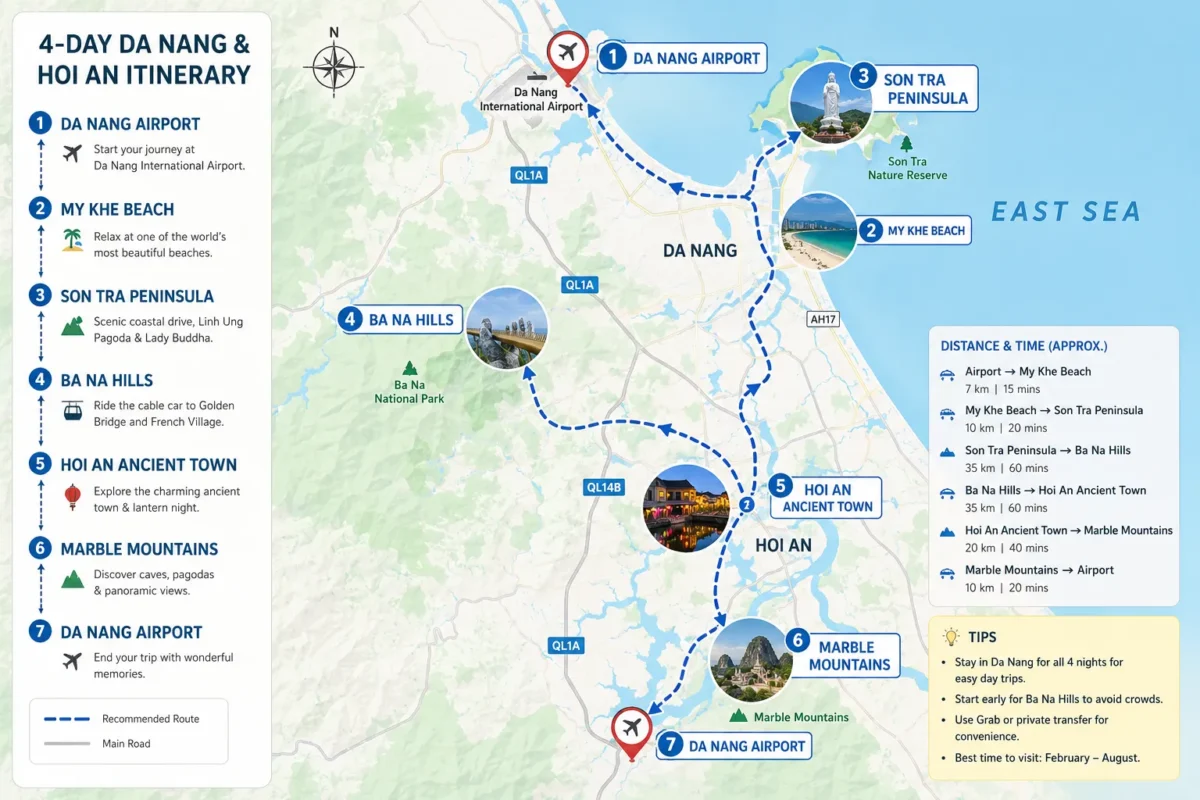
ROUTE MAP
Your Route Through Central Vietnam
One of the biggest mistakes first-time visitors make is changing hotels too often.
Instead, stay in Da Nang for all four nights and take day trips from there.
This itinerary follows a simple route:
Da Nang Airport
↓
My Khe Beach
↓
Son Tra Peninsula
↓
Ba Na Hills
↓
Hoi An Ancient Town
↓
Marble Mountains
↓
Da Nang Airport
WHY THIS ITINERARY WORKS
Why This Is The Best First-Timer Itinerary
Most online itineraries try to cram too much into too little time.
This guide is different.
Instead of rushing between destinations, you’ll focus on the highlights that actually matter.
You’ll avoid:
Long unnecessary transfers
Hotel hopping
Tourist scams
Overcrowded schedules
And you’ll experience:
Vietnam’s most famous bridge
The country’s most charming old town
Beautiful beaches
Great local food
Stunning mountain viewpoints
For first-time visitors, this balance is hard to beat.
Before You Start: Choose Your Base
Our Recommendation: Stay in Da Nang
For most first-time visitors, we recommend staying in Da Nang for all four nights.
Why?
Because it offers:
Easier airport access
Better hotel value
More beachfront accommodation
Faster access to Ba Na Hills
Convenient day trips to Hoi An
Instead of changing hotels midway through your trip, use Da Nang as your base and visit Hoi An as a day trip.
Best Areas To Stay
My Khe Beach (Recommended)
Best for:
First-time visitors
Couples
Families
Pros:
✓ Walking distance to the beach
✓ Great restaurant selection
✓ Easy Grab availability
✓ Excellent hotel value
Da Nang City Center
Best for:
Budget travelers
Food lovers
Pros:
✓ Cheaper accommodation
✓ Local atmosphere
Cons:
✗ No beach access
Hoi An Ancient Town
Best for:
Returning visitors
Slow travelers
Cons:
✗ Further from airport
✗ Less convenient for Ba Na Hills
✗ Requires more transfers
Best Hotels For This Itinerary
Budget ($20-$40)
Sea Near Me Hotel
Fivitel Boutique
Grand Sea View
Mid-Range ($50-$100)
Sala Danang Beach Hotel
Chicland Hotel
TMS Hotel Da Nang Beach
Luxury ($120+)
InterContinental Danang Sun Peninsula Resort
Hyatt Regency Danang Resort & Spa
Furama Resort Danang
Day 1: Arrival in Da Nang, Beaches & Sunset Views
Morning: Arrive at Da Nang International Airport
Da Nang International Airport is one of Vietnam’s easiest airports to navigate.
Immigration is generally faster than in Hanoi or Ho Chi Minh City, and the city center is only around 15 minutes away.
After collecting your luggage, your first priorities should be:
1. Get Connected
You’ll need internet access immediately.
Options include:
eSIM
Local SIM card
International roaming
For most visitors, an eSIM is the simplest option because it works as soon as you land.
2. Avoid Airport Taxi Confusion
You’ll likely be approached by multiple drivers offering rides.
While many are legitimate, prices can vary significantly.
Instead:
We recommend that you only use ride-hailing apps such as Grab and Green SM. (Green SM is Vietnam’s electric ride-hailing service, featuring a fleet of mostly new vehicles that provide a comfortable and high-quality travel experience).
Use pre-booked transfers.
Confirm prices before entering any taxi.
A ride to My Khe Beach typically takes around 15–20 minutes. Since most drivers do not speak English, you can use translation tools such as Google Translate to communicate with the driver
Where to Stay
For this itinerary, the best area is My Khe Beach.
Why?
Because you’re close to:
The beach
Restaurants
Cafés
Nightlife
Main attractions
At the same time, you’re only a short drive from:
Son Tra Peninsula
Marble Mountains
Airport
Hoi An transfer routes
For first-timers, it’s easily the most convenient location.
Afternoon: Relax at My Khe Beach
After a flight, don’t immediately jump into sightseeing.
Take a slower start.
My Khe Beach stretches for several kilometers and is one of the most pleasant urban beaches in Southeast Asia.
Unlike many beaches in the region, it feels clean, spacious, and surprisingly uncrowded outside peak holiday periods.
Spend a few hours:
Walking along the shoreline
Watching local fishermen
Enjoying fresh coconut water
Recovering from jet lag
This slower pace helps you adjust to Vietnam before the busier days ahead.
Late Afternoon: Son Tra Peninsula
If you only have time for one scenic drive in Da Nang, make it Son Tra Peninsula.
Often called the “Green Lung of Da Nang,” this mountainous peninsula offers a completely different atmosphere from the city below.
Within minutes, you’ll move from busy streets to winding coastal roads surrounded by jungle.
Highlights include:
Linh Ung Pagoda
Home to the famous Lady Buddha statue.
Standing approximately 67 meters tall, it’s one of Vietnam’s largest Buddhist statues.
The viewpoint here offers spectacular views over:
Da Nang City
My Khe Beach
The East Sea
Scenic Viewpoints
Along the peninsula you’ll find numerous viewpoints perfect for photos.
Late afternoon is the best time to visit because:
Temperatures are cooler
Light is softer
Visibility is often better
Evening: Dragon Bridge
Dragon Bridge is one of Da Nang’s most recognizable landmarks.
During the day it’s simply a bridge.
At night, it’s part of the city’s identity.
The illuminated dragon becomes a centerpiece of the waterfront skyline.
If you’re visiting on a weekend, try to catch the famous fire and water show.
Arrive early because crowds gather quickly.
Even if you miss the show, the riverside atmosphere makes for a pleasant evening walk.
Dinner Recommendations
For your first night, focus on local specialties.
Mi Quang
A regional noodle dish unique to Central Vietnam.
Unlike pho, it’s served with less broth and a richer flavor profile.
Bun Cha Ca
Fish cake noodle soup.
Popular among locals and ideal after a day of exploring.
Fresh Seafood
Da Nang is famous for seafood restaurants.
Choose places with strong local crowds rather than tourist-heavy waterfront venues.
Local Tip for Day 1
Don’t rent a scooter immediately after arriving.
Many travelers underestimate:
Traffic patterns
Road rules
Weather conditions
Using Grab for the first day is safer and often cheaper than expected.
Day 2: Ba Na Hills & Golden Bridge
If Day 1 is about easing into Vietnam, Day 2 is about experiencing one of the country’s most famous attractions.
Ba Na Hills has become an iconic destination thanks to the Golden Bridge.
However, there’s far more to see than the bridge itself.
And timing makes a huge difference.
Start Early
This is the single most important tip for the entire itinerary.
Leave early.
Very early.
The majority of tour groups arrive between:
9:30 AM – 11:30 AM
After that, queues become significantly longer.
Aim to arrive before the crowds.
The difference in experience can be dramatic.
Getting to Ba Na Hills
From Da Nang:
Travel time: 45–60 minutes
Shuttle bus available
Private transfer available
Grab may be available but return transport can be less predictable
For first-time visitors, a pre-arranged transfer is often the simplest option.
The Cable Car Experience
Even before reaching the Golden Bridge, you’ll experience one of the longest cable car systems in the world.
The journey itself is part of the attraction.
As you climb higher:
Dense forests appear below
Clouds drift across the mountains
Temperatures become noticeably cooler
For many visitors, this is the first real “wow moment” of the day.
Golden Bridge
The star attraction.
Supported by giant stone hands emerging from the mountainside, the Golden Bridge quickly became one of Vietnam’s most photographed landmarks.
Photos rarely capture its true scale.
The best strategy:
Visit immediately after arrival
Take photos first
Explore later
This avoids the largest crowds.
Many visitors make the mistake of treating Ba Na Hills as a one-photo destination.
They arrive, take pictures at the Golden Bridge, and leave within an hour.
That’s a shame because some of the most enjoyable parts of the complex are hidden beyond the bridge itself.
Explore the French Village
After visiting the Golden Bridge, continue to the French Village.
Designed to resemble a European mountain town, the village features:
Stone plazas
Church-inspired architecture
Scenic viewpoints
Cafés and restaurants
Street performances
Is it authentically French?
Not really.
Is it fun?
Absolutely.
Especially for first-time visitors.
The cooler mountain climate creates a completely different atmosphere compared to the tropical heat of Da Nang below.
Take your time walking through the area rather than rushing from attraction to attraction.
Le Jardin D’Amour
Often overlooked by visitors, these gardens are among the most beautiful areas in Ba Na Hills.
The landscaped flower gardens offer:
Colorful photo opportunities
Fewer crowds
Relaxing walking paths
If you visit during the morning, you’ll usually find the gardens much quieter than the Golden Bridge.
Lunch at Ba Na Hills
Food inside Ba Na Hills tends to be more expensive than in Da Nang.
That’s expected since everything must be transported up the mountain.
Options include:
Buffet restaurants
Fast food
Local Vietnamese dishes
The buffet restaurants generally offer the best value.
Don’t expect a culinary highlight here—the attraction is the scenery rather than the food.
Afternoon: Enjoy the Mountain Atmosphere
One of the best things about Ba Na Hills is simply slowing down.
Many travelers spend the entire day chasing photos.
Instead:
Enjoy the cooler temperatures
Walk the quieter paths
Take in the mountain views
Vietnam itineraries often move too quickly.
This is one place where slowing down pays off.
Return to Da Nang
Most visitors return to the city around late afternoon.
Back in Da Nang, you’ll probably be tired after a full day of walking.
Keep the evening simple.
Dinner Ideas
Try local specialties such as:
Banh Xeo (Vietnamese savory pancakes)
Nem Lui (lemongrass skewers)
Seafood hotpot
Then enjoy a relaxed evening by the beach.
Tomorrow is the cultural highlight of the itinerary.
Day 3: Hoi An Ancient Town & Lantern Night
If Da Nang represents modern Vietnam, Hoi An represents its historical soul.
For many international visitors, Hoi An becomes the most memorable part of the trip.
The atmosphere is completely different.
Life moves slower.
The streets are quieter.
The architecture tells stories from centuries of trading history.
Morning: Travel to Hoi An
The distance between Da Nang and Hoi An is relatively short.
Travel time typically ranges from:
30–45 minutes
depending on traffic.
You can use:
Grab
Taxi
Shuttle bus
Private transfer
For simplicity, Grab is often the easiest option.
Try to arrive before 9:00 AM when temperatures are still comfortable.
Explore Hoi An Ancient Town
The UNESCO-listed Ancient Town is best explored on foot.
Unlike many historical districts around the world, Hoi An still feels alive rather than preserved behind glass.
You’ll find:
Local homes
Small cafés
Tailor shops
Temples
Markets
all mixed together.
The charm comes from wandering.
Don’t rush.
Allow yourself time to get lost.
Japanese Covered Bridge
One of Hoi An’s most recognizable landmarks.
The bridge dates back hundreds of years and reflects the multicultural history that shaped the town.
It’s worth visiting early in the day before tour groups become larger.
Traditional Houses & Assembly Halls
Throughout the Ancient Town you’ll encounter beautifully preserved buildings.
Many visitors skip these attractions because they seem less exciting than lanterns and riverside photos.
That’s a mistake.
These sites provide context that helps explain why Hoi An became one of Southeast Asia’s most important trading ports.
Lunch: Taste Hoi An’s Signature Dishes
Hoi An has some of Vietnam’s most distinctive regional cuisine.
Three dishes deserve special attention.
Cao Lau
Perhaps the town’s most famous dish.
Unlike pho or bun bo Hue, Cao Lau has a texture and flavor unique to Hoi An.
White Rose Dumplings
Delicate dumplings filled with shrimp and served with crispy toppings.
Com Ga
Hoi An-style chicken rice.
Simple but incredibly satisfying.
Afternoon: Cam Thanh Coconut Village
A short distance from the Ancient Town lies Cam Thanh Coconut Village.
This area is known for:
Water coconut forests
Basket boat rides
Traditional fishing culture
Basket boat rides have become extremely popular with tourists.
Some travelers love them.
Others find them a little touristy.
The truth is somewhere in the middle.
It’s a fun activity as long as expectations remain realistic.
Think of it as a cultural experience rather than a wilderness adventure.
Sunset in Hoi An
As daylight fades, Hoi An transforms.
This is when the town truly comes alive.
The golden sunlight reflects off the old yellow buildings while lanterns begin appearing throughout the streets.
Find a riverside café.
Order a Vietnamese coffee.
Slow down.
Watch the town change from day to night.
This is one of those travel moments that stays with people long after the trip ends.
Evening: Lantern Night
For many visitors, this becomes the highlight of the entire Vietnam trip.
The lantern-lit streets create an atmosphere unlike anywhere else in the country.
You’ll see:
Glowing lanterns
Street musicians
Food vendors
Riverside activity
The town becomes busier after sunset, but the atmosphere remains charming.
Local Tip
Avoid choosing restaurants directly along the busiest riverside stretch.
Prices are often higher and quality isn’t always better.
Walk a few streets away and you’ll usually find:
Better value
Better food
More local customers
Return to Da Nang
Most visitors return around 9–10 PM.
The drive is short enough that staying in Da Nang remains convenient.
Day 4: Marble Mountains, Coffee Culture & Departure
Your final day combines one last major attraction with a slower cultural experience before departure.
Morning: Marble Mountains
Located between Da Nang and Hoi An, Marble Mountains is one of the easiest attractions to include before heading to the airport.
The site consists of limestone hills filled with:
Temples
Pagodas
Caves
Viewpoints
Arrive early to avoid both crowds and heat.
Exploring the Caves
The caves are among the most fascinating parts of Marble Mountains.
Sunlight streams through openings in the rock, creating dramatic lighting conditions.
Many visitors find these caves more memorable than expected.
They feel ancient, spiritual, and surprisingly peaceful.
Viewpoints
Several viewpoints offer panoramic views over:
Da Nang
The coastline
Surrounding countryside
Bring water and comfortable shoes.
You’ll encounter plenty of stairs.
Lunch & Vietnamese Coffee Experience
Before leaving Vietnam, spend time experiencing one of the country’s greatest cultural treasures:
Coffee.
Vietnam is one of the world’s largest coffee producers, and coffee culture here is deeply woven into daily life.
Try one of these classics:
Coconut Coffee
Rich, cold, and refreshing.
Perfect in Da Nang’s tropical climate.
Salt Coffee
Originally from Central Vietnam.
The combination sounds unusual but works remarkably well.
Egg Coffee
More common in northern Vietnam but increasingly available nationwide.
Last-Minute Souvenirs
Popular choices include:
Coffee
Local snacks
Lanterns
Handmade products
Avoid shopping at the airport whenever possible since prices are usually higher.
Airport Transfer
Allow at least:
2 hours before departure
for international flights.
Although Da Nang Airport is efficient, unexpected traffic can still occur.
Where to Stay for This Itinerary
Choosing the right location matters more than choosing the perfect hotel.
For most first-time visitors, My Khe Beach is the ideal base.
Budget Hotels ($20–40)
Best for:
Backpackers
Solo travelers
Budget-conscious couples
Expect:
Clean rooms
Good location
Basic amenities
Mid-Range Hotels ($50–100)
The sweet spot for most travelers.
You’ll often get:
Swimming pools
Excellent breakfast
Walking distance to the beach
This category usually offers the best overall value.
Luxury Resorts ($120+)
Ideal for:
Honeymooners
Families
Luxury travelers
Many beachfront resorts offer:
Ocean views
Spa facilities
Private beach access
Cost Breakdown
How much should you budget?
Here’s a realistic estimate for a first-time traveler.
Category
Cost (USD)
Hotel
$80–180
Food
$40–70
Local Transport
$15–40
Ba Na Hills
$40–60
Miscellaneous
$20–50
Total
$220–450
This makes Central Vietnam one of the best-value destinations in Asia.
Common Mistakes First-Time Visitors Make
Mistake #1: Staying in Hoi An for the Entire Trip
Hoi An is beautiful.
But using it as your only base often creates unnecessary transportation time.
Da Nang is usually more practical.
Mistake #2: Arriving at Ba Na Hills Too Late
After 10:00 AM, crowds increase dramatically.
Early arrivals enjoy a completely different experience.
Mistake #3: Taking the First Airport Taxi Offered
Always compare prices.
Grab often provides more transparent fares.
Mistake #4: Trying to Add Hue to This Itinerary
Hue deserves at least one full day.
Trying to squeeze it into this itinerary usually makes the trip feel rushed.
Mistake #5: Ignoring the Weather Forecast
Central Vietnam experiences distinct rainy and dry seasons.
Weather can significantly affect beach days and outdoor attractions.
For first-time visitors to Vietnam, few destinations offer a better combination of convenience, culture, food, scenery, and value than Da Nang and Hoi An.
You don’t need two weeks.
You don’t need a complicated route.
And you certainly don’t need to rush through half the country.
Follow this itinerary, stay flexible, and leave room for spontaneous discoveries.
That’s often when the best travel memories happen.